
History
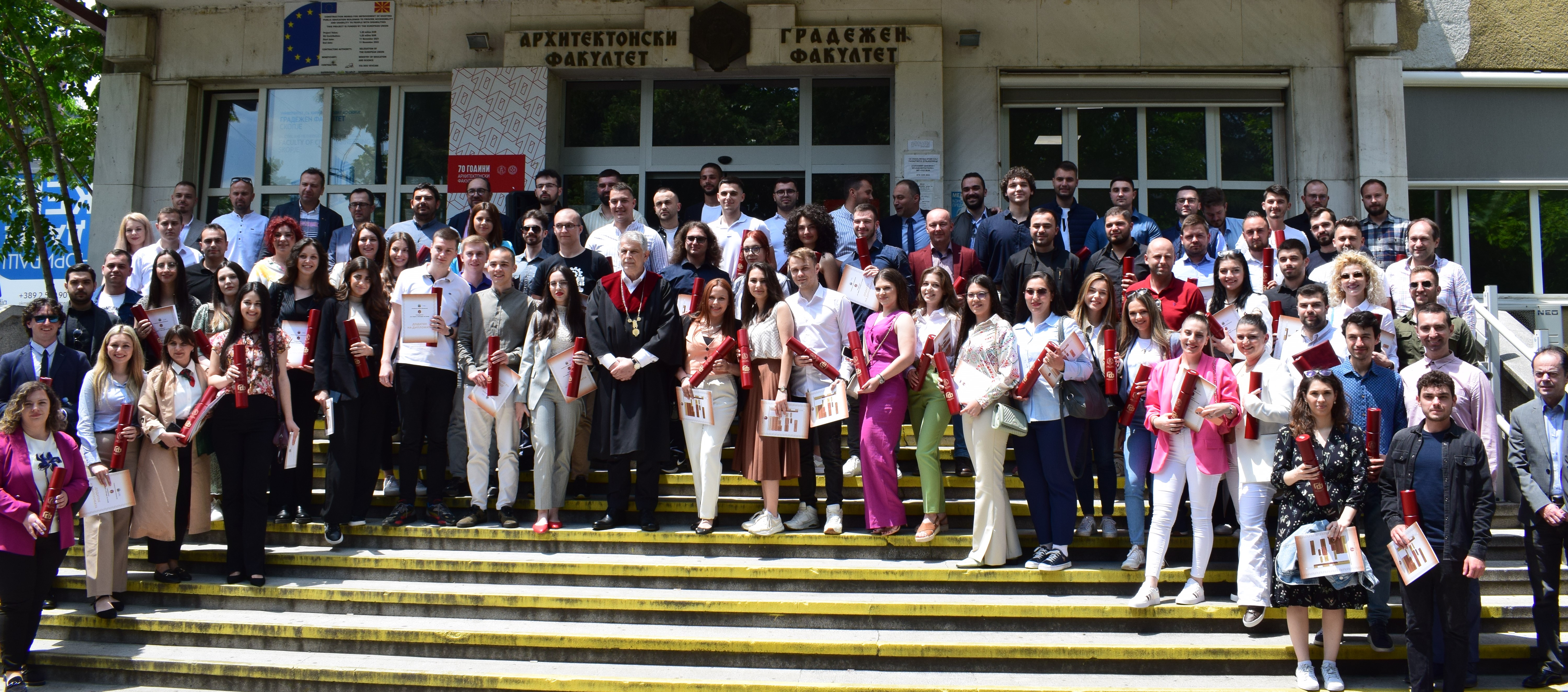
The FACULTY OF CIVIL ENGINEERING is the oldest technical faculty in North Macedonia,founded in 1949 and an integral part of the largest university in our country, Ss. Cyril and Methodius University.
The Faculty's Day is celebrated on 6 October, the day on which the first class for civil engineering students was held, in 1949, in the amphitheatre of the then Technical Faculty.
Officially, the founding act of the Technical Faculty, which consisted of two divisions (Civil Engineering and Architecture), was published as an act of the Government of the People's Republic of Macedonia in the Official Gazette No. 34 of 28 December 1950.
Later, by an act of the Government of the Socialist Republic of Macedonia, the Technical Faculty was divided into the Faculty of Civil Engineering and Architecture, the Faculty of Electrical and Mechanical Engineering, and the Faculty of Technology and Metallurgy (Official Gazette of the SRM No. 27/1965 of 30 June 1965).
By the founding act No. 03-660/1 of 22.04.1975, the Faculty of Civil Engineering and the Faculty of Architecture were constituted as separate faculties.
During that period, teaching at the Faculty of Civil Engineering was organised in three tracks: structural engineering, hydraulic engineering, and roads and railways.
Studies in geodesy began in 1978 as five-semester studies.
Studies in geotechnics began in 2005 .
Today, the Faculty of Civil Engineering is a highly regarded public higher education institution that carries out educational, scientific research, applied and publishing activities in the fields of civil engineering, geotechnics and geodesy.
The basic mission of the Faculty of Civil Engineering is education and professional training, as well as advancing the overall functioning of our society towards the ideals set by the countries of Europe.
It pursues this basic goal through:
- producing highly educated professionals in the fields of civil, geotechnical and geodetic engineering at the undergraduate, postgraduate and doctoral levels;
- encouraging and carrying out scientific research activity;
- continuous cooperation with industry, primarily with construction practice, drawing on its experience and offering in return the results of the Faculty's own research;
- besides the professional training of students, an extremely important factor is their development into well-rounded individuals, with their own views on community life and the drive to take part in it;
- implementation of the European Credit Transfer System – ECTS.
Starting from September 2013, all study programmes at the Faculty are delivered according to the ECTS 3+2+3 model.
The first three (3) years are devoted to the first cycle of studies (undergraduate studies) in the following study programmes:
– Civil Engineering
– Geodesy
– Geotechnical Engineering
The next two (2) years are devoted to the second cycle (postgraduate studies), where teaching is delivered in the following study programmes:
– Civil Engineering, Structures
– Civil Engineering, Hydraulic Engineering
– Civil Engineering, Transport Infrastructure
– Geodesy
– Geotechnical Engineering
– Real Estate Management
The first cycle of studies lasts six semesters and carries 180 ECTS credits; the second cycle lasts four semesters and carries 120 credits.
The third cycle – doctoral studies – has been offered since 2011 in one study programme, Civil Engineering, with several modules; it lasts six semesters and carries 180 credits.
Details about the study regime and lectures can be obtained on this website and from the Vice Dean for Teaching.
Teaching is organised and delivered by 41 full professors, associate professors and assistant professors, 11 teaching assistants and doctoral students, and a larger number of student associates in the second and third cycles of studies.
The Faculty has two amphitheatres and 17 classrooms with a total area of about 1,700 m².2.
In addition, for education the Faculty has seven laboratories, a modern computer centre and a library with a large number of titles.
Modern software tools are used in the teaching process, and the Faculty is fully covered by wireless internet.
The website is regularly updated, and, among other things, lectures and exercises are posted in electronic form on the pages of the departments.
In parallel with teaching, the Faculty pays great attention to scientific work and applied, practical activity in civil engineering, geodesy, geotechnics and related scientific disciplines.
The Faculty regularly holds a large number of seminars, practical trainings, workshops, student conferences and more, where, besides theoretical aspects, practical aspects of civil engineering, geodesy and geotechnics are analysed.
The Faculty is always open to its students and graduate engineers and has established excellent communication with construction companies and industry, which has led to fruitful mutual cooperation.
A Scholarship Foundation for the best students has been established at the Faculty as one of the best forms of cooperation with construction companies, so that scholarships are an additional motivation and incentive for students.
The Student Parliament at the Faculty of Civil Engineering is the most significant form of student organisation, where students develop their ideas for improving the study process and the development of the Faculty.
Dear studentsduring your studies make use of your potential to acquire the knowledge and skills that will enable you to reach the highest level of professionalism and an excellent reputation in our society.
Without doubt, you will spend the most beautiful moments of your career with us, enjoying the beauty of working and socialising together.
The motto of the Faculty of Civil Engineering is that in history only those who build and unite people are remembered.
You are choosing a wonderful profession that creates free and creative individuals capable of making intelligent and brave decisions when creating buildings.
This wonderful profession offers a great opportunity for your structures to remain as lasting landmarks in the space and time of your work.