
1FUTURE
Project title:
Partners For Sustainability – joint action for environmental, social and economic sustainability in Western Balkan HEIs
Acronym: 1FUTURE
Program:
ERASMUS + K2 Higher Education Capacity Building in Western Balkan Countries (EAC/A02/2019)
Duration: 36 months (April 2023-April 2026)
Project Website: https://1future.feut.edu.al/
PROJECT description
Sustainability research and sustainability action is today a necessity and a challenge for higher education. A full integrated approach to sustainability research and action is missing in our Balkan Region. While research centers and research teams are working on different aspects related to sustainability action, the inclusion and integration of areas such as climate change, disaster risk management, land use, urban development and energy markets is missing. The capacities to implement sustainability concept can be empowered through qualitative education and so all the citizens will benefit from sustainable development. Universities can perform their role through their experience in different levels of education (learning and teaching at undergraduate, graduate, professional and executive training). This requires full cooperation in different levels of faculty and University, and possibly a intra-university approach.
Higher education contribution to sustainability can be achieved in many ways:
- Conduct courses including sustainability topics at undergraduate and graduate level
- Training of curriculum developers and professors on sustainability issues and their targets.
- Provide capacity building courses on sustainability to other stakeholders
- Exercise pressure for the implementation of public education policies in favor of sustainability education
As sustainability is a broad term and is related to social, economic and environmental issues, universities are indispensable for its achievement. A higher education environment enables the establishment of the connection between the functions of learning and teaching, research and administration/governance which sometimes have been addressed separately. A sustainability center, linked to the higher education governance structure, is a place where such connection can be made possible.
The inclusion of sustainability topics in the curriculum and institution activities implies coping with challenges related to current ways of thinking and organizing; still they are beneficial for the boosting of the quality of learning and students’ experience. So universities should identify ways to become a mechanism for achieving Sustainability. In order to achieve the inclusion of sustainability in higher education activities it is necessary to identify the challenges of the country, find the appropriate solutions and prioritize the resources. Apart from that this achievement require the collective willingness of decision makers, public and private sector and civil society to act. The universities’ contribution will be really effective if there is greater articulation between scholarships, innovative solutions, strategic partnerships and activism to support country strategies to achieve the sustainability goals.
In the context of this project it is intended to address the above mentioned issues through the relevant objectives defined by the project partners.
The specific project outputs are:
- Development and implementation of research centers targeting sustainability issues in partner countries HEIs, in accordance to regional needs and contemporary EU trends. The centers would include 4 pillars of sustainability action: climate change and disaster risk management; urban development; energy markets; corporate social responsibility.
- Inclusion of sustainability modules in Bachelor and Master level in partner HEIs, or modernization of teaching content of already established sustainability modules.
- Continuous professional development of employees in sustainability field in WBC, through creation and implementation of certified LLL courses for practitioners.
- Creation of one sustainability journal, produced by the research center in UT, where each partner would contribute.
- Development and implementation of summer schools, organized by partner HEIs.
- Improved cooperation between project partners in order to modernize teaching and training process on novel technical and technological solutions, exploiting the ICT application.
- Implementation of sustainable management practices within university services.
The project will combine social and technical fields in order to fully cover the topics of sustainability.
Partners:
- University of Tirana (Albania) – COORDINATOR
- LUND University (Denmark)
- Eberswalde University for Sustainable Development (Germany)
- IUAV University of Venice (Italy)
- University of Novi Sad (Serbia)
- Cyril and Methodius University in Skopje (North Macedonia)
- University of Montenegro (Montenegro)
- University of Tuzla (Bosnia and Hercegovina)
- University College “CEPS-Center for Business Studies” Kiseljak (Bosnia and Herzegovina)
- Polytechnic University of Tirana (Albania)
- LUARASI University (Albania)
- NGO-Građevinarstvo – nauka i praksa – Podgorica (Montenegro)
- Chamber of Engineers of Montenegro (Montenegro)
- The Institute for nature Conservation in Albania INCA (Albania)
- The Chamber of Commerce and Industry Tirana (Albania)
- The National Agency for Scientific Research and Innovation (Albania)
- Association for Risk Management AZUR (Bosnia and Hercegovina)
- The Chamber of Economy of the Federation of Bosnia and Herzegovina (Bosnia and Herzegovina)
Training visit at UKIM
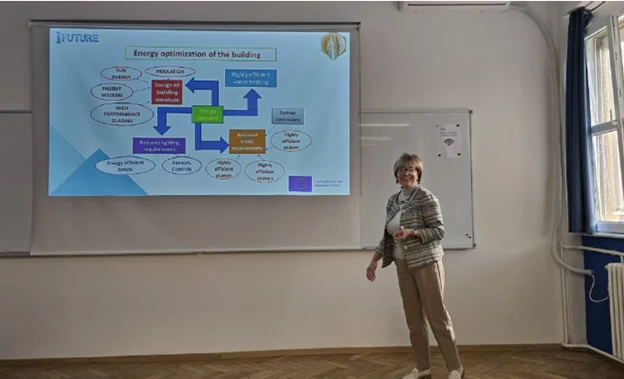
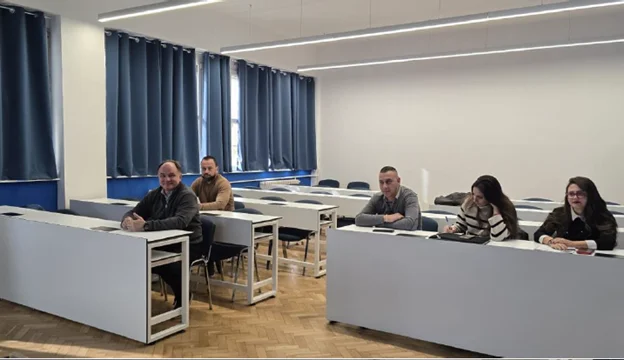
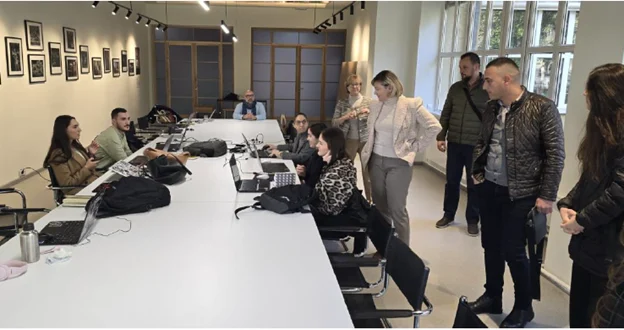
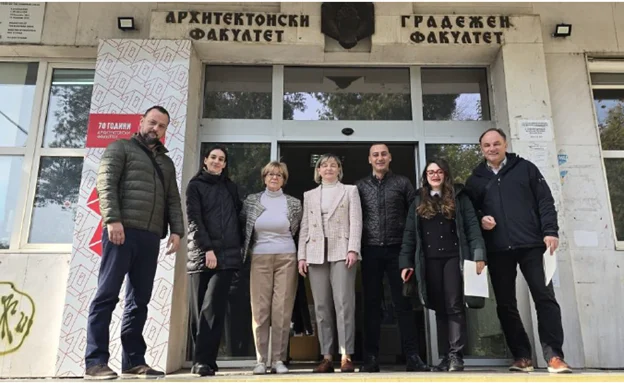
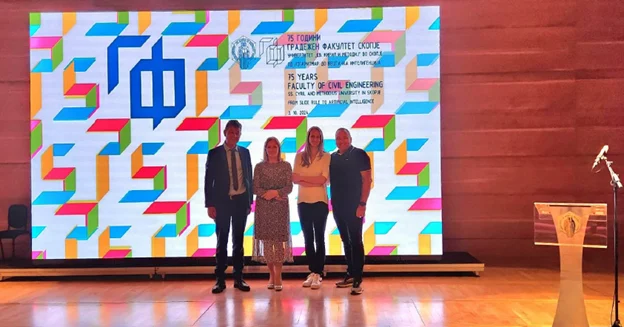
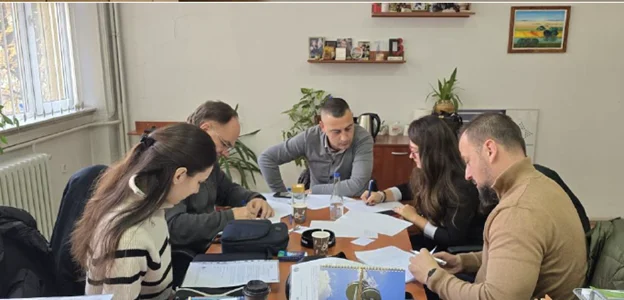
The training for the teaching staff from WBC HEIs was held at the Faculty of Civil Engineering and the Faculty of Architecture, Ss. Cyril and Methodius University in Skopje, in three cycles of five days each. The first cycle took place from 16.09.2024 to 20.09.2024, and the CEPS teaching staff participated in this training cycle. The second cycle was held from 30.09.2024 to 04.10.2024, and the UoM teaching staff participated in this cycle.
The topic of the training was energy efficiency in buildings. The lectures were delivered by Prof. Ognen Marina, who spoke about sustainable urban planning; Prof. Ana Trombeva Gavriloska, who presented the basic principles of energy efficiency; Prof. Meri Cvetkovska, who continued with lectures on methods for designing energy-efficient buildings that meet passive house criteria; and Assistant Professor Liljana Dimevska Sofronievska, who addressed the topic of cultural heritage renovation from the perspective of improving energy efficiency without changing the authentic appearance of the buildings.
The main goal of the training was to familiarize the participants with the course content on energy efficiency in buildings and with the related teaching methods and techniques.
Training Objectives
Sustainable development is directly related to environmental pollution, which largely depends on energy consumption in buildings and the type of energy used. From that reason the proper design of buildings, especially of building envelope, is important for achieving the main goals of energy efficiency and sustainable development. The training in Skopje was dedicated to this topic.
The objectives of the training were: getting familiar with the teaching methods at the host institution, acquiring new knowledge in the field of energy efficiency of buildings, which will help to improve the teaching materials at the home institution, becoming familiar with the results of the host’s research activities and creating conditions for future cooperation and exchanges of the best practice.
1FUTURE- Newsletters:
Edition no.1
https://1future.feut.edu.al/wp-content/uploads/2023/11/1Future_Newsletter_1st_Edition-1.pdf
Edition no.2
https://1future.feut.edu.al/wp-content/uploads/2024/05/1Future_Newletter_2nd_Edition.pdf
Edition no.3
https://1future.feut.edu.al/wp-content/uploads/2024/12/1Future_Newletter_3rd_Edition-1.pdf
Edition no.4
https://1future.feut.edu.al/wp-content/uploads/2025/05/1Future_Newletter_4th_Edition.pdf
Edition no.5
https://1future.feut.edu.al/wp-content/uploads/2025/11/1Future_Newletter_5th_Edition-converted.pdf
Edition no.6
https://1future.feut.edu.al/wp-content/uploads/2026/04/1Future_Newletter_6th_Edition.pdf